“The Ummah of Ahmad”: How Sanandaj Turned the Prophet’s Birthday into a Celebration of Unity
In Iran, Unity Week refers to the period between the two dates observed by Sunni and Shia Muslims for the birthday of the Prophet Muhammad. The occasion is marked every year across the country with a range of cultural and religious programs.
In Iran, Unity Week refers to the period between the two dates observed by Sunni and Shia Muslims for the birthday of the Prophet Muhammad. The occasion is marked every year across the country with a range of cultural and religious programs.
One of these events is Mehmani-ye Ommat-e Ahmad (“The Ummah of Ahmad Gathering”), a popular celebration held in cities across Iran. Centered on the Prophet’s birthday, the event seeks to highlight common ground among Muslims and promote solidarity between Sunni and Shia communities.
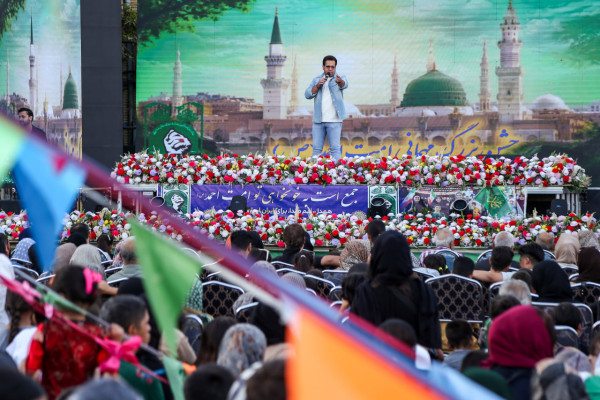
This year, the fourth edition of the celebration was held in several provinces, including Sanandaj, the capital of Kurdistan Province and one of Iran’s major Sunni-populated regions. Cultural and artistic programs, along with the large turnout, transformed the city’s central streets into the setting for a public celebration.
On Friday, August 28, 2026, Sanandaj hosted the fourth edition of Mehmani-ye Ommat-e Ahmad, a popular cultural event held during Unity Week and in connection with celebrations marking the Prophet Muhammad’s birthday. The event takes its name from “Ahmad,” one of the names traditionally attributed to the Prophet.
Residents of Sanandaj and other cities across Kurdistan Province attended the celebration, alongside groups from other parts of Iran and visitors from countries in the region.
In Iran, Unity Week denotes the period between the two dates observed by Sunni and Shia Muslims for the Prophet’s birthday. Sunni Muslims believe that the Prophet Muhammad was born on August 25, while the Shia tradition marks his birth on August 30.
To avoid turning the differing dates into a source of division, Iran observes the intervening period as Unity Week, using the occasion to emphasize solidarity between the country’s Sunni and Shia Muslim communities. Since the Islamic Revolution, the occasion has been promoted in Iran as an opportunity to focus on the religious commonalities shared by Sunnis and Shias.
Mehmani-ye Ommat-e Ahmad is held within this broader cultural context. The Prophet’s birthday serves as an occasion for bringing people together and highlighting Muslim solidarity.
Holding the celebration in Sanandaj carries particular significance. Kurdistan is one of Iran’s major Sunni-populated regions, where a significant part of the population is Sunni Muslim. A public celebration centered on the Prophet’s birthday and on common ground between Sunnis and Shias therefore carries not only religious significance, but also a broader social and cultural message.
Sanandaj’s Historic Urban Fabric Welcomes Ahmad’s Guests
This year’s celebration was held along the pedestrian route from Ferdowsi Walkway to Enghelab Square in central Sanandaj. The area lies within the city’s historic and cultural fabric and, owing to its commercial activity and heavy pedestrian traffic, is one of the city’s busiest public spaces.
The conversion of Ferdowsi Street into a pedestrian walkway was carried out with the aim of improving the urban environment, reducing traffic-related problems, boosting tourism and creating a space for social and cultural interaction.
For several years, the route has served as one of the city’s public spaces suitable for community gatherings, urban programs and street celebrations.
When the People Become the Hosts
One of the defining features of Mehmani-ye Ommat-e Ahmad is public participation in organizing the event.
At the fourth edition, 133 community-run stations offered refreshments, local food, Quranic activities, children's programs and a range of cultural and social services and community groups from various provinces of Iran taking part, alongside guests from countries in the region. In addition to residents of Sanandaj, visitors from Lebanon, Syria, Iraq, Palestine, including Gaza attended the celebration.
The stations offered refreshments, prepared and served local dishes, hosted Quranic programs and activities for children and teenagers, and provided a range of cultural and social services. In this way, people were not merely spectators; they also played an active role in organizing the celebration.
Some stations also offered religious counseling and answers to religious questions, while others featured children’s painting and intellectual games, as well as displays of cultural and religious products.
Children at the Heart of the Celebration
Children were among the most visible participants at the event. A dedicated stage, play equipment and entertainment programs were provided for them, while children’s and teenage groups also performed throughout the celebration.
The Kurdistan provincial broadcaster also organized special programs for children. Alongside games, performances and entertainment, the programs were designed to allow children to take an active part in the atmosphere of a family-oriented celebration.
Music at the Heart of the Prophet’s Birthday Celebration
Daf playing and Mawlid chanting —religious chanting in celebration of the Prophet’s birth—formed an important part of the program. Both are musical and vocal traditions associated with religious and traditional culture in Iran, particularly in Kurdish regions, and are commonly performed on occasions such as the Prophet’s birthday.
Daf is a circular frame drum, traditionally made with a wooden frame and a membrane of animal skin, with metal rings or jingles attached to the frame. It holds a distinctive place in Iranian music, particularly in the mystical and ritual traditions of the country’s western regions.
Daf playing group performances at religious ceremonies are commonly accompanied by religious songs and poetry, making the instrument a familiar feature of celebrations marking the Prophet’s birthday.
Mawlid chanting is a traditional form of devotional singing featuring poetry and verses in praise of the Prophet Muhammad, and religious figures are recited or sung. The tradition has a longstanding cultural presence in Iran’s Kurdish regions and forms part of public celebrations of the Prophet’s birthday there.
At the Sanandaj celebration, one of the city’s well-known daf playing groups performed on stage.
Payam Azizi, a prominent Iranian singer known for his works in mystical and ritual music, also performed Mawlid chanting at the event. Many of his performances have a direct connection to themes surrounding the Prophet.
Television Actors and Personalities Join the Crowd
At public and cultural celebrations in Iran, the presence of well-known actors, singers and television personalities is often a prominent feature, helping draw larger crowds. These figures typically appear alongside the public, take to the stage and contribute to the entertainment program through comedy, storytelling or interaction with attendees.
The Kurdish comedy group Nagheleh Kordi also performed during the celebration. Nagheleh Kordi is a comedy and magazine-style radio program made up of various segments. It broadcasts daily by the Kurdistan provincial radio network and has attracted a considerable following for its humorous style.
In its fourth year, Mehmani-ye Ommat-e Ahmad turned Ferdowsi Street and Enghelab Square in Sanandaj, into a shared space for celebration, hospitality, cultural activities, music and entertainment, for several hours.
In a city with a substantial Sunni Muslim population, the event used the Prophet Muhammad’s birthday as an occasion to bring people together and highlight their shared religious and cultural heritage.
2026-09-02