An Overview of the Educational Model of Iran’s Sadra Schools
Sadra Schools of Islamic Sciences and Teachings in Iran combine general education with specialized study of the Quran and Islamic teachings. Their students also take part in scientific, literary and religious competitions, offering a glimpse into the range of activities available alongside their regular studies.
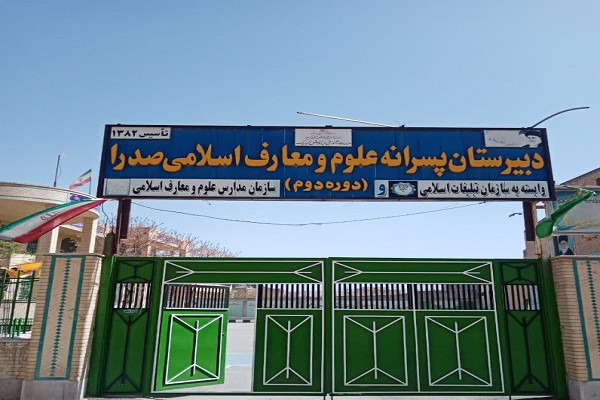
Sadra Schools of Islamic Sciences and Teachings in Iran combine general education with specialized study of the Quran and Islamic teachings. Their students also take part in scientific, literary and religious competitions, offering a glimpse into the range of activities available alongside their regular studies.
General Education Alongside Islamic Studies
Supported by Iran’s Islamic Propagation Organization, Sadra Schools operate for both boys and girls in cities across the country. Their curriculum covers general academic subjects as well as specialized courses in the Quran and Islamic teachings.
The Islamic Sciences and Teachings track is offered at the upper-secondary level, the final stage of school education before higher education. Graduates may continue their studies at universities or Islamic seminaries.
Scientific Research and Youth Literature
Fatemeh Abdollahi and Niayesh Yousefi, students at a Sadra school in Bojnurd, the capital of North Khorasan Province in northeastern Iran, received top national rankings in the stem-cell category at the seventh national festival for student research centers.
Student research centers in Iran support school students in exploring scientific subjects, developing research projects and gaining practical experience. Their festivals provide a platform for students to present their work and compete for recognition in different fields of science and technology.
In literature, Inas Kiani, a student at a Sadra school in Khorramshahr, received top recognition at the county level and an outstanding provincial ranking in a youth creative-writing competition in which participants develop written responses to a picture prompt. Khorramshahr is in Khuzestan Province in southwestern Iran, near the border with Iraq.
A Sadra girls’ lower-secondary school in Mehriz, in central Iran’s Yazd Province, also placed second in the national Danashahr event. The event aims to develop students’ scientific and practical skills and give them opportunities to demonstrate their abilities.
Religious Studies: From the Quran to Nahj al-Balagha
Fatemeh Obiyavi, a student at a Sadra school in Ahvaz, won first place in Quran interpretation at the 44th National Student Competition on the Quran, the Prophet Muhammad’s Progeny, and Prayer. Another Sadra student from Khorramshahr placed second nationally in the interpretation of Nahj al-Balagha, a collection of sermons, letters and sayings attributed to Imam Ali, a central figure in Shia Islam.
The national competition brings together students from across Iran in disciplines related to Quran recitation and memorization, interpretation of religious texts, teachings associated with the Prophet Muhammad’s progeny, and prayer. Depending on the category, participants demonstrate their knowledge through recitation, memorization or interpretation.
In Iran’s 2026 national university entrance examination, several Sadra students also achieved rankings in different subject groups. The nationwide examination, commonly known in Iran as the Konkur, is used in the university admissions process.
These achievements illustrate the range of activities pursued by Sadra students, from scientific research and creative writing to the study of the Quran and other Islamic texts. Alongside their regular academic studies, these activities form part of the educational experience offered by the schools.
2026-10-25